Vaca Muerta has 30.170 billion barrels of technically recoverable oil, almost double the estimate made just over a decade ago, according to a new study conducted by the Argentine Institute of Oil and Gas (IAPG) at the request of the Secretariat of Energy.
The new figure represents an increase of 89% compared to the 16.220 billion barrels calculated in 2013 by the U.S. Energy Information Administration (EIA) and redefines the scale of Argentina's main unconventional resource.
Vaca Muerta would have almost double the projected potential
The survey does not refer to proven reserves or immediate production, but rather to technically recoverable remaining resources, that is, oil that could be extracted during the useful life of the formation using currently available technology and under industry standards.
The study was requested by the Secretariat of Energy in October 2025 and coordinated by the IAPG. Specialists from YPF, Pluspetrol, Pan American Energy, Pampa Energía, Vista, Chevron, and Tecpetrol participated, along with technicians from UBA, the National University of La Plata, and the national government.
The evaluation used a probabilistic volumetric analysis under the international PRMS 2018 standard and allowed for an updated comprehensive measurement of oil potential that had not been conducted for approximately 15 years.
The jump is mainly due to three factors. First, the useful prospective area increased by 22%, with an expansion of the areas considered suitable towards the south of Mendoza and Río Negro. Additionally, the useful thickness of the formation grew by 39%, due to a greater identification of rock levels that can be developed.
The third factor was the improvement in the recovery factor, which increased by 54% thanks to accumulated advances in drilling, hydraulic stimulation, and defining the optimal distance between wells.
During the AmCham Energy Forum, the Secretary of Energy and Mining Coordination, Daniel González, highlighted that the updated volume represents, at the current production level, nearly 100 years of extraction, while using current export levels as a reference would equate to approximately 250 years.
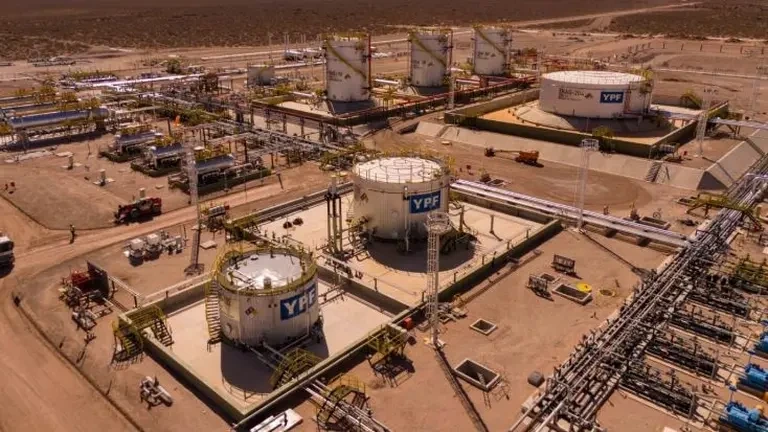
Vaca Muerta, Neuquén
The government considers that the challenge now is to transform that enormous geological potential into production, exports, and generation of foreign currency. To achieve this, it will be necessary to support the growth of upstream with new transportation and evacuation infrastructure.
In this strategy, projects such as Vaca Muerta Oil Sur (VMOS), which will initially have the capacity to transport 550,000 barrels per day to the Atlantic, and initiatives related to liquefied natural gas appear. The Executive also points to RIGI as a tool to facilitate financing and accelerate large-scale investments.