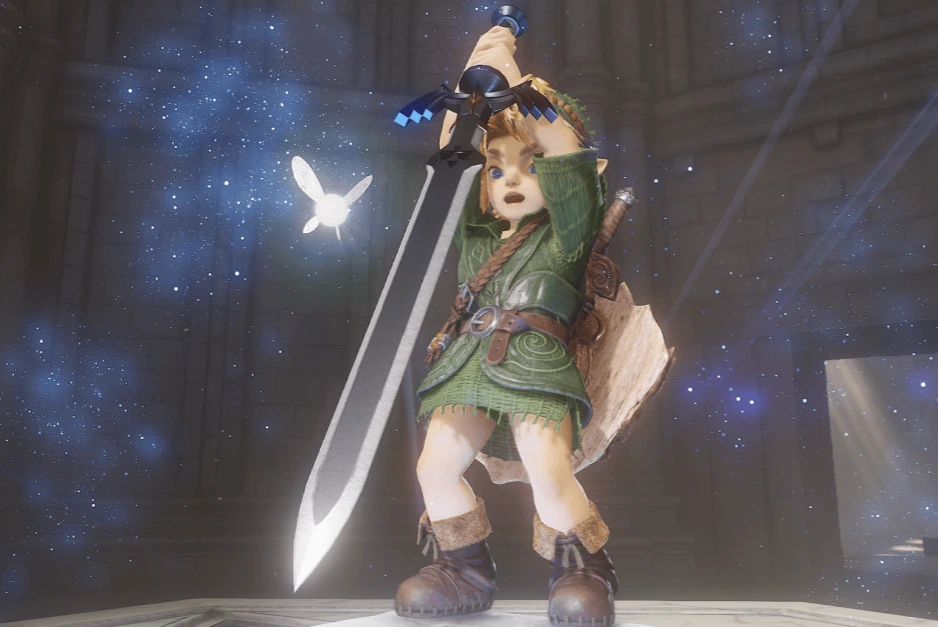

Nintendo is preparing for one of its most important releases of 2026 with the return of The Legend of Zelda: Ocarina of Time, one of the most influential video games in history. The Japanese company will launch an exclusive remake for Nintendo Switch 2 this Thursday, November 5, exactly 28 years after the original version was released on Nintendo 64.
The title will feature a complete visual overhaul, improved controls, and new features aimed at modernizing the experience. However, Nintendo has decided to maintain the essence of the 1998 video game, in a bet that combines the nostalgia of veteran players with the expectations of a new generation.
The release comes during a season marked by major industry productions, including Grand Theft Auto VI from Rockstar Games, against which Nintendo will seek to stand out with the return of one of its most recognized franchises.
Zelda Ocarina of Time returns after 28 years with completely renewed graphics
The remake of The Legend of Zelda: Ocarina of Time represents a significant transformation from the version originally released in 1998.
Nintendo has rebuilt the visual aspect of the video game with more detailed environments, redesigned characters, and a considerably more realistic aesthetic, taking advantage of the technical capabilities of Nintendo Switch 2.
The new version also incorporates an orchestral soundtrack, expanded cinematic scenes, and voice acting for the characters, elements that aim to provide a more immersive experience.
However, the company's goal is not to develop a completely different adventure, but to recover Link's original journey through Hyrule.
Players will once again explore the iconic settings of the title, face its enemies, and solve the characteristic puzzles of the franchise.
The story will maintain as its core the struggle of Link against Ganondorf and his attempt to seize the Triforce, a central element of the Zelda universe.

The new features that Zelda Ocarina of Time will have on Nintendo Switch 2
One of the main novelties will be related to the protagonist's movements.
Unlike the original video game, Link will have a specific button to jump and a new feature that will allow him to run faster, offering more direct control over his movements.
This decision modifies one of the characteristic aspects of Ocarina of Time, where jumps were executed automatically when approaching certain edges.
Improvements will also be made to the camera control, which can be managed with greater freedom using the right joystick.
Another important change will be the incorporation of voice acting in narrative scenes, accompanied by expanded dialogues and a renewed audiovisual presentation.
Additionally, Nintendo announced a feature called Threads of Time, which will allow players to check their progress within the story.
This tool will show completed events and provide indications about upcoming objectives, facilitating the continuity of the adventure.
The system will be especially useful for those who interrupt their games for several days and need to remember what they were doing or where they were supposed to go.
Nintendo will preserve the essence of the original Nintendo 64 video game
Although the technical novelties will be numerous, the remake will maintain fundamental elements of Ocarina of Time released in 1998.
The original video game represented a turning point for Nintendo by moving the Zelda franchise into three-dimensional environments and establishing new forms of exploration, combat, and puzzle-solving.
Its structure combined connected environments, dungeons, special items, and challenges that had to be completed following specific events in the story.
This design contrasts with the orientation that the franchise adopted later, especially after the release of The Legend of Zelda: Breath of the Wild.
With that title, Nintendo introduced a philosophy centered on player freedom, allowing players to traverse vast open environments and overcome obstacles through different strategies.