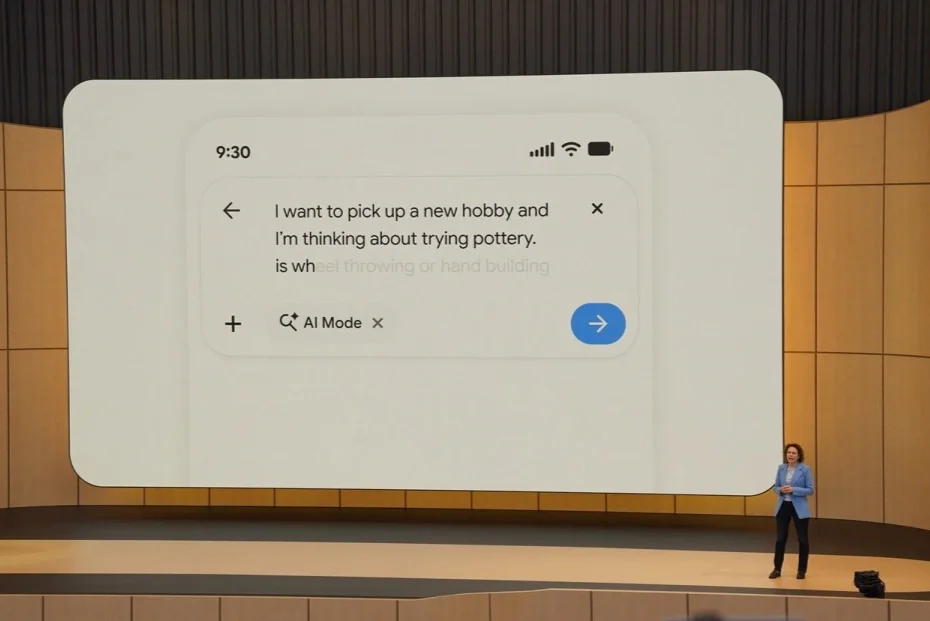
Google presented at its I/O event a vision where its traditional search bar evolves to become a hub that solves almost any task. Instead of just showing links, it now seeks to answer, personalize, and even act on behalf of users in an integrated manner.
The search bar becomes more dynamic and expands as you type longer queries. It offers AI-driven suggestions that go beyond traditional autocomplete, which can complete ideas in unexpected ways.
The results also change: AI summaries allow for continued questioning in a conversational mode that generates personalized pages instead of classic lists of links. Additionally, Google will generate customized interfaces with graphics and interactive images directly on the search page.
Information and Personalization Agents
One of the new features is the ability to create “information agents” from the bar to follow specific topics, such as sneaker releases or apartment listings. It works as an enhanced AI version of Google Alerts.

In Gemini, the improvements are significant. It can now send a daily summary of your day using data from Gmail, Calendar, and other apps. The Gemini Spark feature allows for the creation of personalized agents with the advantage of being a proprietary Google product.
The company emphasizes “personal intelligence” that combines context from your various applications to provide more precise and useful answers. Everything points to AI understanding your digital life better and acting accordingly.
Changes in Workspace and Shopping
In Workspace, the idea is to speak directly to Gmail, Docs, or Keep to help organize emails, draft documents, or create task lists. For shopping, the Universal Cart arrives, tracking products in Search, Gemini, Gmail, and YouTube, and allowing checkout with Google’s payment system.
YouTube is also testing a mode similar to search with AI, which creates personalized pages instead of just showing videos. And with the new Gemini Omni models, it will be possible to generate videos by combining other videos, images, and audio as prompts. The promise is to create almost any type of multimedia content.
In summary, Google no longer just indicates where the information is: it seeks to directly resolve what you need in the most useful way possible. The underlying vision is a single “Ask Google” box that manages everything without jumping between applications.
Concerns about the Impact
While it may be very practical, this approach poses significant challenges. It requires extremely high precision, especially with sensitive data such as years of emails in Gmail or complex queries.
Moreover, if people stop browsing websites and videos because AI answers everything, it could affect traffic to creators and publishers who rely on those visits to sustain themselves. Google seems to be betting heavily on this total integration, but the cost to the open internet ecosystem raises doubts.
In the end, the proposal is convenient, but many still value the process of searching, discovering, and building their own digital systems. The challenge for Google will be to implement all this accurately and without eliminating the richness that the diverse web currently offers.