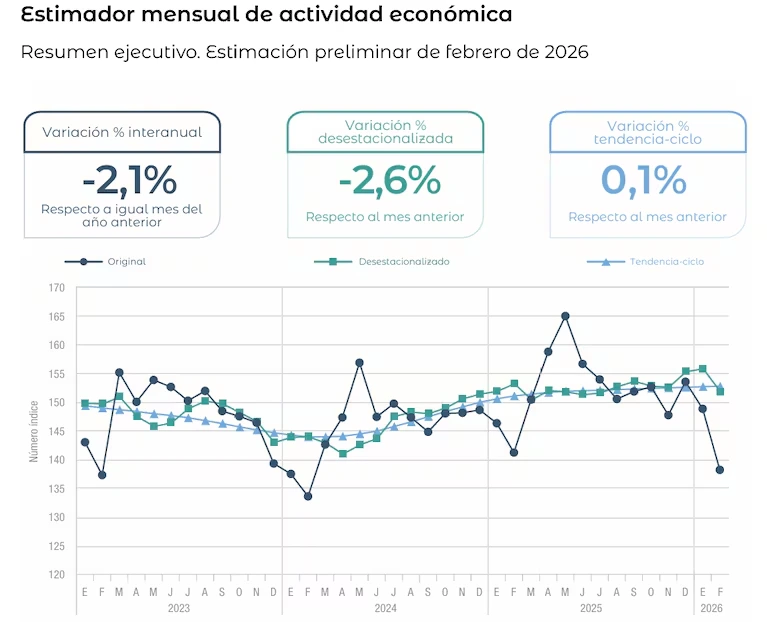
Economic activity in Argentina registered a one-off drop in February 2026, directly explained by the general strike of the CGT, thelower number of working days and the seasonal nature of the month.
These factors had a full impact on production and the normal functioning of the economy, although a key fact from INDEC confirms the continuity ofeconomic growth.
According to the agency's report, the Monthly Estimator of Economic Activity (EMAE) showed a fall of 2.6% compared to January and a decrease of 2.1% year-on-year, while the first two months of the year accumulated a decline of 0.2%.
The main factor behind this fall was the general strike of February 19, which generated an economic loss estimated at USD 575 million, equivalent to about 0.8% of monthly GDP.
The stoppage of public transport was decisive, since it prevented the transfer of workers and slowed down activity in key sectors such as industry and commerce, which were the most affected in that month.
INDEC data.
Another key element is the seasonal nature of February, historically one of the least active months in Argentina. During this period, many industries carry out technical shutdowns, maintenance and holidays, which reduces production and is reflected in official statistics.
This type of event impacts activity through three mechanisms: the direct loss of production during the strike, the effect of fewer working days and the temporary slowdown in some industries.
In February, in addition, an additional factor was added: the month had two fewer business days than in 2025 (18 against 20), which reduced total productive capacity and amplified the year-on-year decline.
The sectors most affected were precisely those most sensitive to interruptions in transport and consumption due to the strike of the CGT. The manufacturing industry fell 8.7% and trade declined 7%, reflecting the direct impact of the measure of force and the lower circulation of goods and
people. Javier Milei and Luis Caputo.
In contrast, activities less dependent on urban movement managed to sustain themselves and even grow. Fishing increased 14.8%, mining and quarrying 9.9% andagriculture and livestock 8.4%
, showing a different dynamic.
The economy continues to grow
.
However, when analyzing the underlying trend, the picture changes. The trend-cycle component of the EMAE, which eliminates "noises" such as stoppages and seasonal effects, showed an increase of 0.1% per month, indicating that the economy continued to
grow after discounting these factors.
In fact, this indicator accumulated almost two years of uninterrupted expansion, confirming that the fall in February was due to specific factors and not to a general deterioration.
At the same time, the projections for the year as a whole remain positive. Leading agencies and analysts estimate that Argentine GDP will grow between 3.5% and 4% in 2026, consolidating an economic recovery beyond
occasional monthly declines.
Thus, the data show that the February decline was directly linked to the CGT strike and the lower number of working days, while the general trend of the economy continues to expand.