

The new organic charter of the Central Bank, the decrease in the inflation rate, the increase in exports, less debt with international financial organizations, and greater capital inflow are the levers for growth in 2026
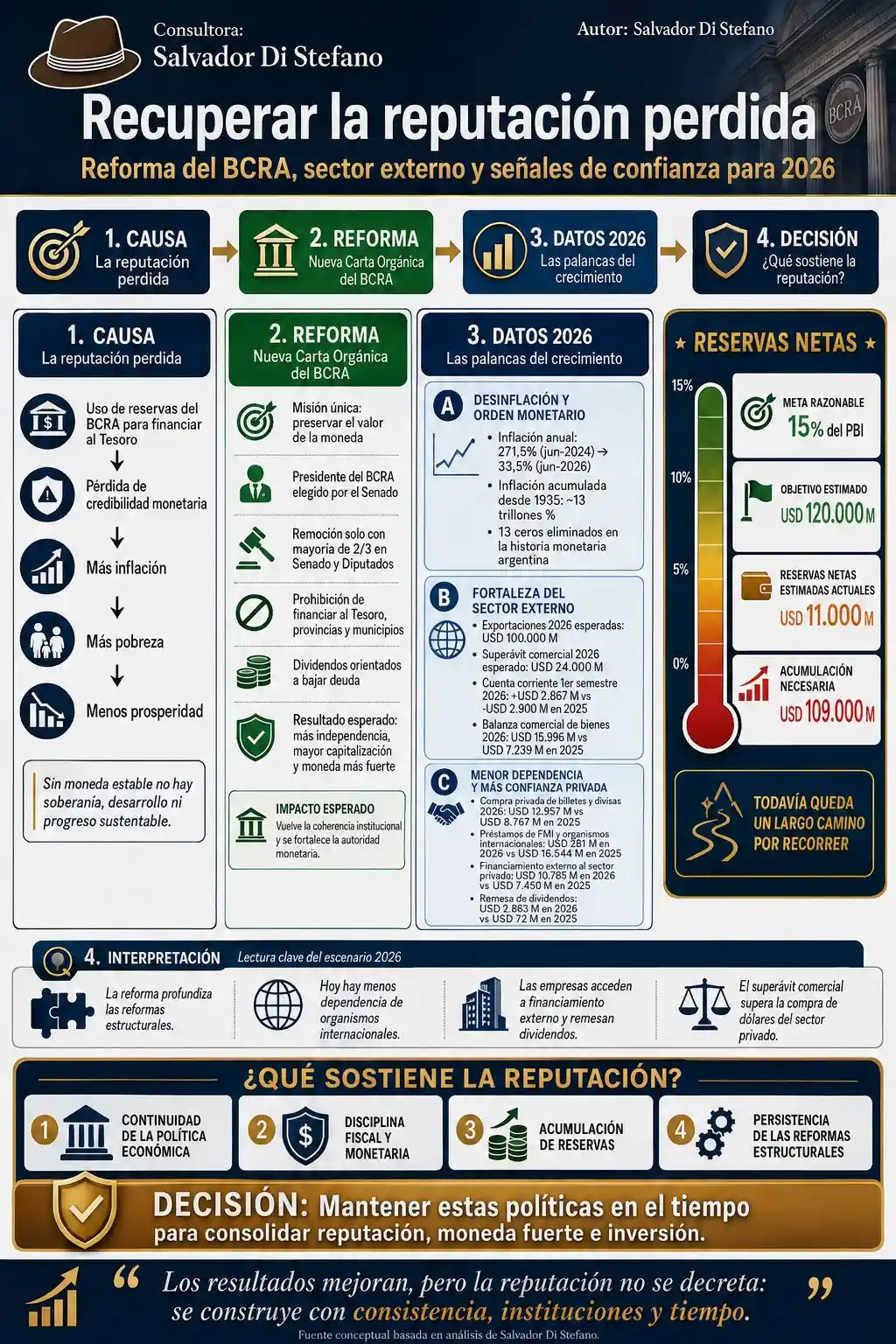
The reform of the organic charter of the Central Bank of the Argentine Republic (BCRA) will allow the country to regain its lost reputation. The indiscriminate use and abuse of the BCRA's reserves to finance the treasury has left us with a history of disappointments, leading to an increase in inflation, more poverty, and consequently less prosperity for Argentines.
The mission of the BCRA ended up being a set of statements that contradicted each other and did not allow for the essential postulate for an economy, which is to preserve the value of the currency. Without currency, there is no possible sovereignty, sustainable development, and progress. The only mission that the BCRA will now have is to preserve the value of the currency. Coherence has returned.
With the reform of the organic charter, a much stronger Central Bank will be born. The president will be elected by the Senate and can only be removed by a 2/3 majority in both the Senate and the Chamber of Deputies. This will provide stability in the position of the country's monetary authority.
On the other hand, the Central Bank will not be able to finance the Treasury, provinces, and municipalities that have financing problems, which will allow it to accelerate the capitalization process; dividends will be used to reduce debt rather than being distributed, and it will allow us to have a strong currency.
Do not complain if there is no devaluation; we will have to be more productive and competitive, through greater investment.
The main challenges for Argentina
The reserves of the Central Bank should be 15% of GDP; therefore, the goal is for them to eventually total U$S 120 billion, net of bank reserves or swaps taken in the market. Although there is no official estimate of net reserves, they would amount to approximately U$S 11 billion, which implies that to achieve a reasonable goal that allows us to sleep peacefully, we need to accumulate reserves of about U$S 109 billion.
Argentina has a long road ahead. The problems will not be solved overnight, given the inherited situation. The reform of the BCRA's organic charter is a brilliant move by President Javier Milei, who presented a figure that reflects the accumulated inflation in our country since the Central Bank was created in 1935, amounting to 12,819,532,788,614,400,000%, a figure very difficult to repeat, and we simplify it by saying that our inflation from 1935 to date has been 13 trillion.
Argentina has experienced a path of destruction of its currency with the elimination of 13 zeros, almost a record among countries on the planet. Currently, the country has significantly reduced inflation from a peak of 271.5% annually in June 2024 to 33.5% in June 2026. From here on, the hardest path lies ahead, which is to bring inflation down to a single digit, something that will take time to achieve, as has happened in other countries, but we have no doubt that the implementation of sound fiscal and monetary policies will allow us to reach this goal in more reasonable timeframes.
The results of fiscal order
Meanwhile, fiscal and monetary order is yielding astonishing results; in 2026, our exports are expected to reach another U$S 100 billion, and the trade surplus will amount to about U$S 24 billion, something unexpected in previous years.