Wages rose above inflation again in July and extended the real improvement in purchasing power to four consecutive months.
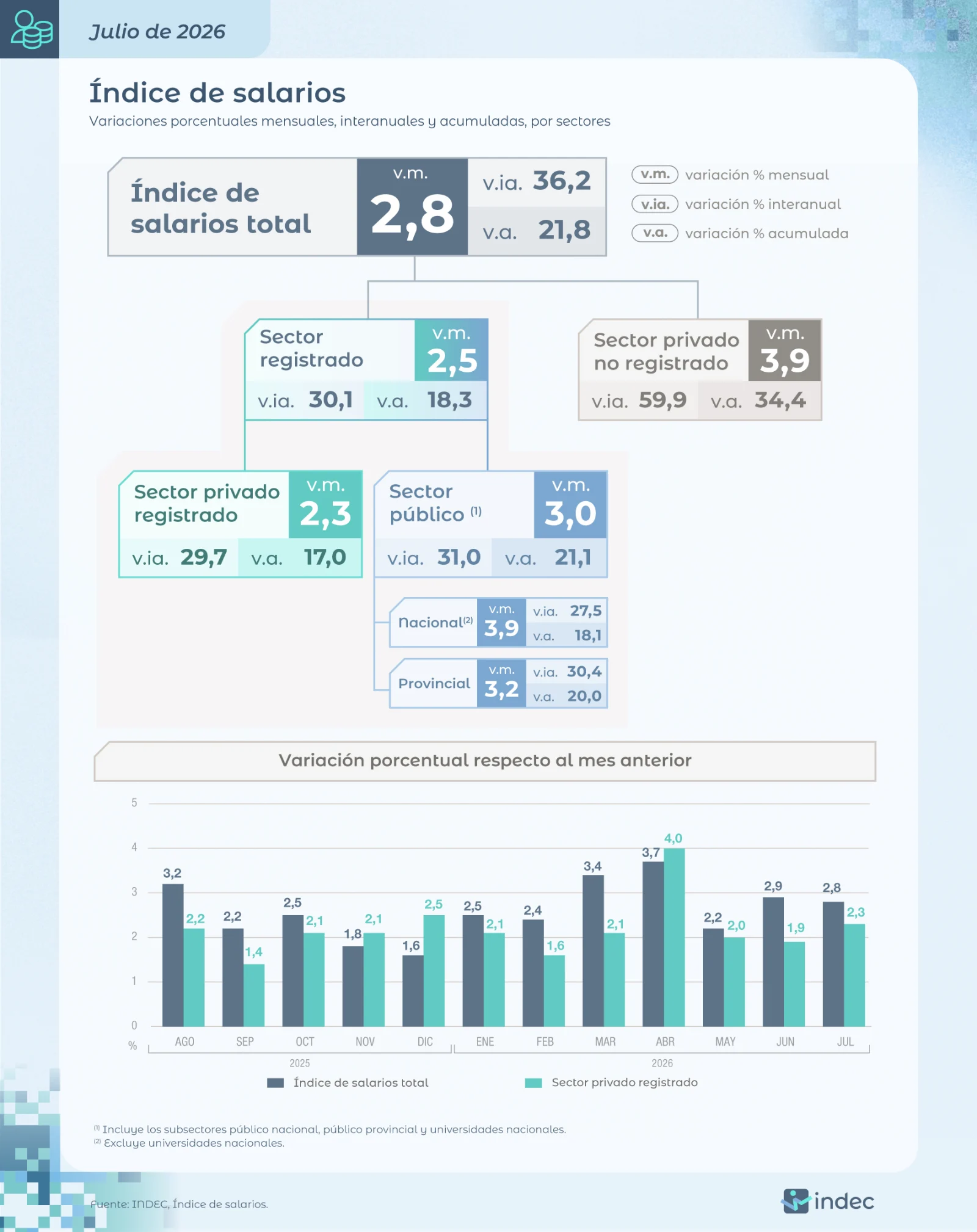
According to data from INDEC published this Tuesday, the Total Salary Index increased by 2.8% in July 2026, while the inflation for the same month was 2.1%.
The difference between both indicators was consistent throughout the period that began in April. In that month, wages increased by 3.7% compared to an inflation rate of 2.6%.
The data from INDEC
In May, the wage increase was 2.2%, against a price rise of 2.1%. In June, wages rose 2.9%, while inflation was 1.9%. Finally, in July, the average remuneration once again exceeded the variation of the CPI, with an increase of 2.8% compared to 2.1%.
Thus, April, May, June, and July marked four consecutive months in which the monthly growth of wages exceeded that of prices.
How wages evolved in July
The behavior varied by sector. The unregistered private sector led the increases in July, with a rise of 3.9%, while the total public sector recorded an improvement of 3.0%.
Meanwhile, the registered private sector had a variation of 2.3%. Thus, all sectors were above the monthly inflation rate of 2.1%
President Javier Milei
In the year-to-date, the Total Salary Index recorded a variation of 21.8%. Within the registered sector, composed of formal public and private workers, the accumulated increase reached 18.3%.
The registered private sector accumulated a rise of 17.0%, while the unregistered private sector reached 34.4%. Meanwhile, the total public sector accumulated an increase of 21.1%.
Four consecutive months above inflation
The sequence of the last four months shows a sustained difference between the evolution of wages and prices. In April, the gap was 1.1 percentage points; in May, it was 0.1 points; in June, it was 1 point; and in July, it was 0.7 points.
The result occurs in a context of deceleration of inflation compared to previous periods, thanks to the successful economic plan of the Government of Javier Milei.
Additionally, INDEC later reported that the CPI for August recorded a monthly variation of 1.7%, representing a new decrease.
Thus, the July data consolidates a trend of four consecutive months in which wages exceeded monthly inflation, with the general remuneration index accumulating a rise of 21.8% from the beginning of the year to the month of July.