Child poverty recorded a significant drop in Argentina during the first quarter of 2026, standing at 42.5% among children and adolescents aged 0 to 17, according to the latest report from the Observatorio de la Deuda Social Argentina (ODSA) of the Catholic University of Argentina (UCA).
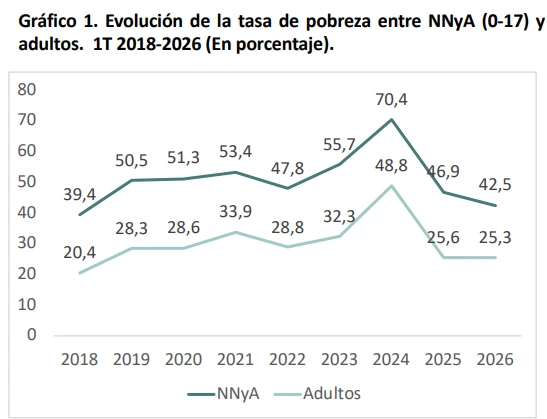
This figure marks a new improvement compared to previous records and reflects a reduction of 27.9 percentage points from the peak of 70.4% reached in the first quarter of 2024, amid the severe economic crisis inherited from Kirchnerism.
President Javier Milei
Thus, under the government of Javier Milei, child poverty has accumulated a marked decrease since that peak and currently stands at below half of the surveyed underage population.
The UCA report reconstructs the evolution of child poverty between 2018 and 2026 based on the first quarters of each year and indicates that the rate steadily increased until 2024, when it reached the highest point in the series.
After Milei took office, however, a downward trend began that continued throughout 2025 and deepened again in 2026.
The child poverty rate, according to UCA
The evolution of child poverty since 2018
The comparison allows us to gauge the magnitude of the change recorded over the last two years. In the first quarter of 2024, poverty affected 70.4% of children and adolescents. A year later, it had decreased to 46.9%, while in the first quarter of 2026 it stood at 42.5%.
The previous trajectory had been very different. According to the report, child poverty rose from 39.4% in 2018 to 50.5% in 2019, 51.3% in 2020, 53.4% in 2021, 47.8% in 2022, and 55.7% in 2023, until reaching the historical maximum of 70.4% in 2024. The document identifies that year as the peak of the crisis and notes that the situation began to reverse afterward.
The rate of child indigence, according to UCA.
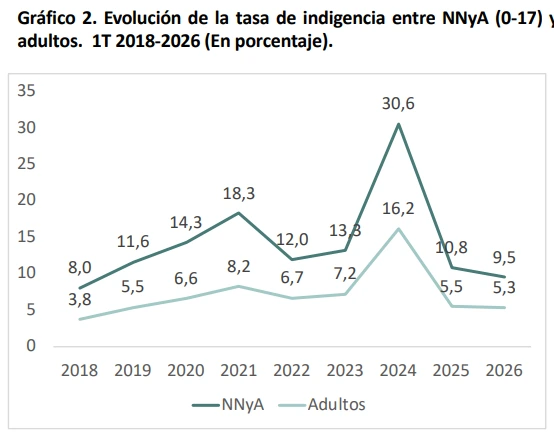
The decline is also observed in child indigence, one of the indicators showing a more pronounced improvement. The rate had reached 30.6% in 2024, nearly doubling the corresponding figure for adults, which was 16.2%. In 2025, it dropped to 10.8% and during the first quarter of 2026, it stood at 9.5%.
The evolution of the last two years is also linked, according to the study, to the role of transfers aimed at households with children and adolescents. The report highlights that the protective capacity of transfers strengthened compared to the most critical period of 2023-2024.
President Javier Milei
The report also shows that, while the recent improvement does not mean that all problems related to child poverty have disappeared, the overall trend of the last two years is clear: after the historical maximum recorded in 2024, child poverty significantly decreased and continued to decline during the first quarter of 2026.
The study, prepared with data from the Permanent Household Survey (EPH) of INDEC corresponding to the first quarters from 2018 to 2026, covers 31 urban agglomerations surveyed by the survey, representing approximately 62% of the total population of the country.