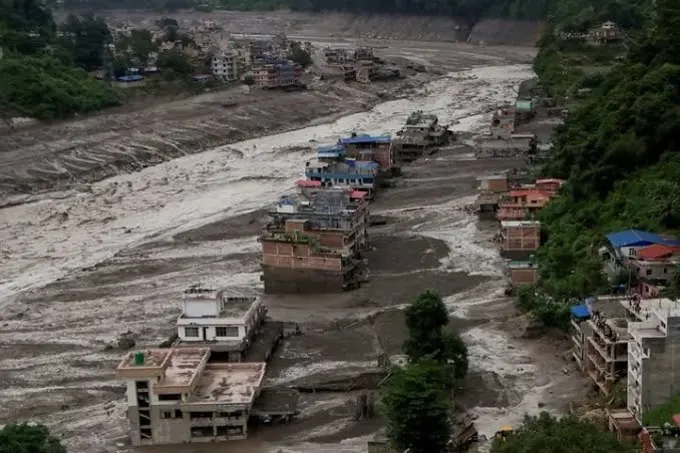
A natural disaster struck the Himalayan region on Wednesday, August 26. At least 98 people have died and hundreds remain missing after a violent flash flood affected the border area between Nepal and Tibet, in China. The Nepalese district of Rasuwa is among the hardest-hit areas.
The force of the water and mud swept away homes, roads, bridges, and hydropower projects. In Tibetan territory, the disaster also reached the Gyirong port, one of the main land crossings in the region, where routes, communications, and electrical connections were interrupted.
However, one of the main questions arising after the tragedy is what caused such a massive flood. Unlike other flash floods, initial assessments indicate that local rainfall would not be sufficient to explain what happened.
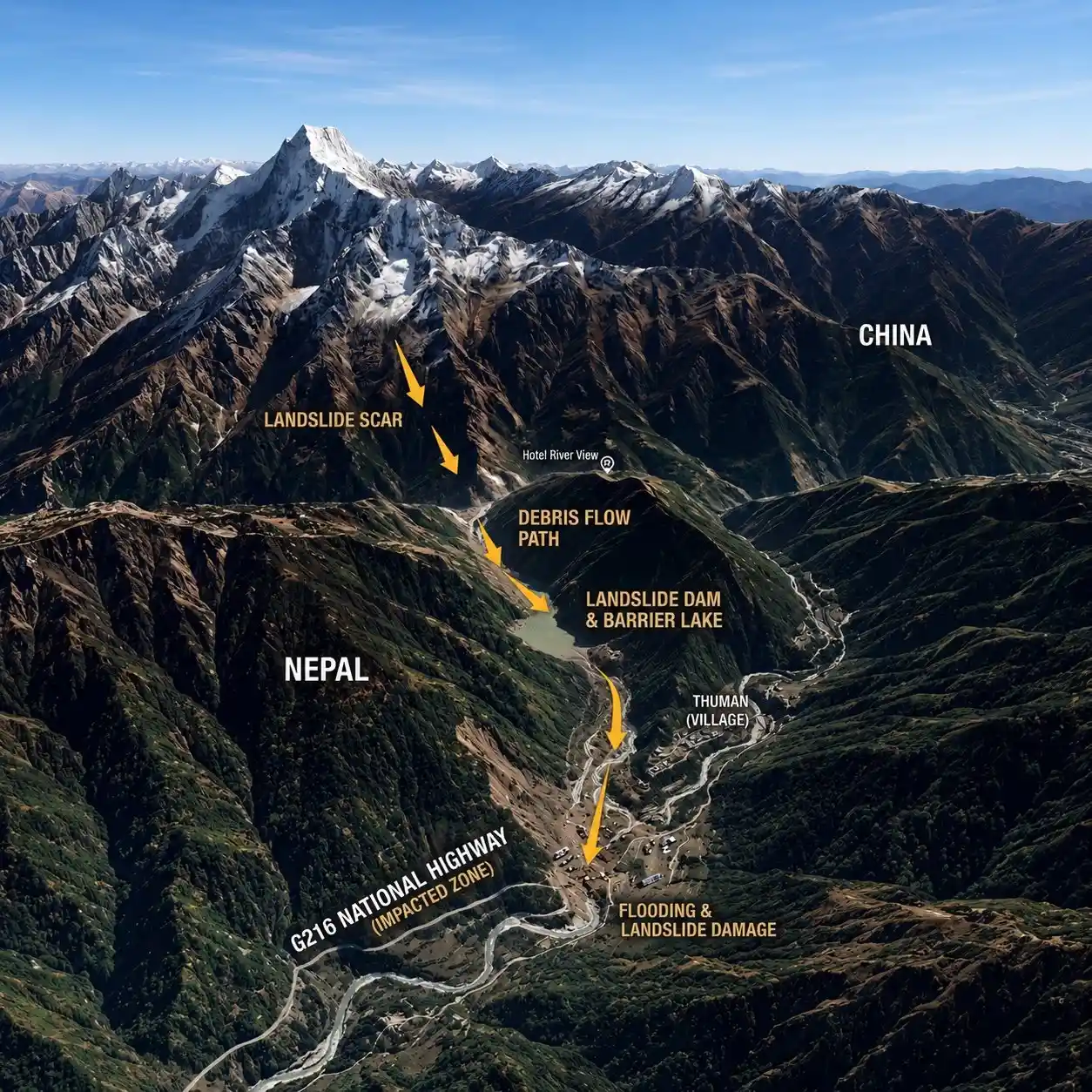
Experts are investigating a complex chain of natural phenomena that may have begun in high-altitude areas: a landslide of ice and rocks may have fallen onto a river, temporarily blocking its course and causing a massive accumulation of water that subsequently descended abruptly down the valley.
What caused the floods between Nepal and Tibet
The investigations are still in a preliminary stage. However, satellite data analyzed by the Nepal National Disaster Risk Reduction and Management Authority detected signs of a snow and rock slide on the border between Nepal and China that could be directly related to the flooding.
One hypothesis is that a recorded earthquake in the region may have triggered a landslide of ice and rocks onto the Lhende Khola river, a watercourse that runs through this mountainous region.
The mechanism can generate devastating consequences. When an avalanche or landslide falls onto a river in a narrow valley, the debris can act as a natural dam. Water continues to flow in, but it is held back by that obstacle.
If that barrier gives way, the accumulated water can be released almost all at once and rush downstream accompanied by mud, stones, ice, and other materials. The result is a flash flood of enormous destructive power, capable of sweeping away structures in a matter of minutes.
Liz Stephens, a professor of Climate Risks and Resilience at the University of Reading, explained that in Nepal and Tibet, such disasters can result from a succession of threats that include landslides, avalanches, and sudden overflows of glacial lakes, which significantly complicates their anticipation.