
The invasion of the barbarians and the battle for civilization

The invasion of the barbarians and the battle for civilization
Imagen de Editorial Team

Most read in Argentina

Óscar Puente filled the Adif dome with socialist militants before the railway tragedy in Spain

  1. Germany: mass looting and terrorist bomb attacks during the alleged "youth marches"

  2. Greece declared the maritime agreement between Turkey and Libya illegal and demands the protection of navigation

  3. They find a wooden wardrobe in a house in Pompeii with amulets and everyday objects

  4. Kicillof arrived in Jujuy during his electoral tour and was met with insults and boos

porEditorial Team
Argentina

Education is not just a tool for transmitting knowledge. It is the mechanism by which a civilization manages to survive over time

Add La Derecha Diario on
Share:

There is a reflection by Thomas Sowell that encapsulates one of the most important issues for understanding the history of civilizations: “Every new generation that is born is, in fact, an invasion of civilization by little barbarians, who must be civilized before it is too late.”

The phrase, published in “A Conflict of Visions” (2007), although very provocative, contains a fundamental truth: no one is born with the knowledge, values, institutions, norms of coexistence, or the intellectual tradition that made possible the world in which they live. Each generation starts practically from scratch.

Thomas Sowell
Thomas Sowell

Civilization, on the other hand, is the result of thousands of years of accumulated knowledge, discoveries, experiences, institutions, and values. And all that heritage must be transmitted again. It is not enough to build a civilization; there is a generational duty to ensure that each generation is capable of understanding it, preserving it, perfecting it, and transmitting it to the next.

Everything that a society took centuries to build can be lost in just one generation.

Education as a Mechanism of Survival

Hannah Arendt addressed this issue in her essay “The Crisis in Education” (1958), later included in “Between Past and Future” (1961). Her argument is particularly interesting: adults have a double responsibility, to the children who come into the world and to the world they must hand over to them.

Education, Arendt argues, is the point at which we assume responsibility for the continuity of that world. Not to prevent new generations from transforming it but to give them the necessary tools to understand it, value it, continue it, and contribute the necessary changes. To innovate, one must first know; to question, one must first understand; and to surpass the knowledge accumulated by previous generations, one must first acquire it. This is precisely the civilizational function of education: to transmit the cultural, scientific, historical, philosophical, and moral heritage that allows a society not to have to start over with each birth.

Here arises a problem that far exceeds the pedagogical: who controls what is transmitted?

Hannah Arendt
Hannah Arendt

Gramsci and the Cultural Battle

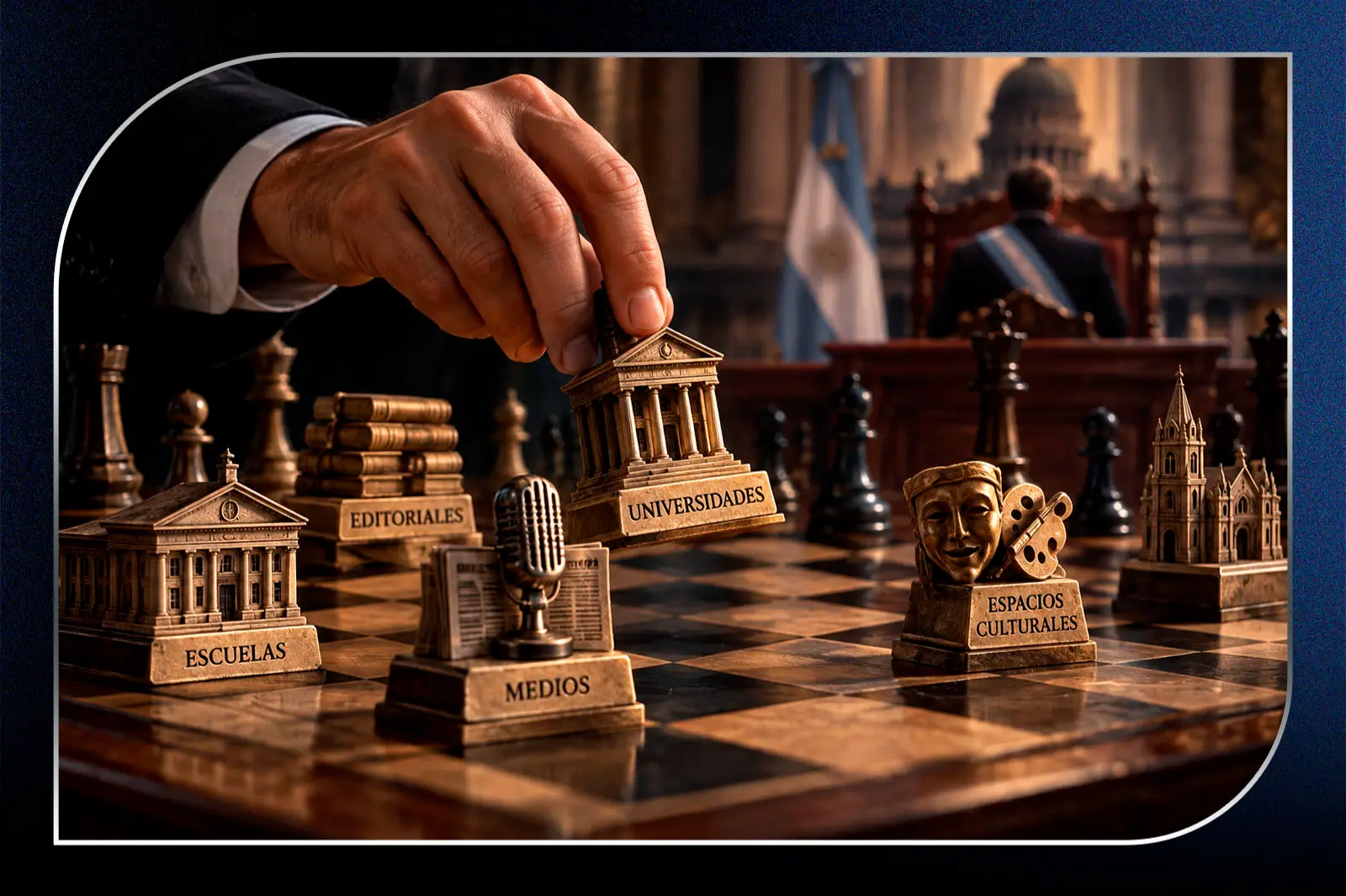
Antonio Gramsci understood that power is not exercised exclusively from the State, through laws, force, or control of economic resources. It is also exercised by building cultural hegemony. In his Prison Notebooks, he developed the idea that the institutions of civil society, intellectuals, schools, and spaces of cultural production are fundamental arenas in the struggle for the common sense of a society.

In this sense, the battle for power, from this perspective, does not begin in elections nor does it end with the conquest of government. It unfolds in classrooms, universities, cultural media, and the spaces where the ideas of the next generations are formed.

Gramsci understood something that many of his adversaries would take a long time to realize: whoever manages to influence the intellectual and cultural formation of a society has the ability to impact its future, to reengineer it to shape society according to their ideological vision.

The Western left understood the strategic importance of education after the failure of the Soviet experiment and, for decades, achieved a decisive influence in sectors of the educational system, universities, teacher training, and intellectual or artistic production.

The dispute ceased to be solely about governing a society. It also became about the formation of those who, years later, would decide how to govern it.

Antonio Gramsci
Antonio Gramsci

There is not even a need for a centralized conspiracy or a single organization. The mere process of cultural hegemony, of the expansion of certain intellectual currents, and of the ability to turn an ideological interpretation of the world into a kind of institutional common sense is sufficient.

The Paradox of Cultural Reproduction

Pierre Bourdieu and Jean-Claude Passeron, in “Reproduction: Elements for a Theory of the Educational System” (1970), studied how the educational system transmits and legitimizes certain cultural schemes and how that transmission can reproduce power relations. Education is not neutral; the contents, the criteria of legitimacy, the methods, and the ways of interpreting reality also express certain worldviews.

  • What happens when an institution whose historical function was to transmit the cultural heritage of a civilization systematically begins to question the foundations of that same tradition?

  • What happens when accumulated knowledge is replaced by ideological content, when intellectual formation yields to indoctrination, and when the understanding of history is replaced by a militant interpretation of the past?

  • What happens when new generations are taught to distrust the institutions, values, and principles that made possible the society in which they live, without even providing them with the intellectual tools to understand them?

The problem is not to question the past. A free civilization needs criticism, debate, and ongoing revision. The problem is that ideological dogma replaces knowledge, substitutes thought, and that deconstruction becomes an end in itself.


La Derecha Diario on X

  1. MÚLTIPLES MUERTOS TRAS LA CAÍDA DE UN AVIÓN EN FLORIDA Un jet privado Learjet 60 se precipitó sobre un parque de casas móviles en Greenacres y desató un incendio de grandes proporciones. El impacto dejó una vivienda destruida, un cráter y cables eléctricos derribados.

    9 min ago

  2. ASÍ QUEDÓ LA ZONA TRAS EL ACCIDENTE AÉREO EN FLORIDA: Nuevas imágenes muestran restos esparcidos, fuego sobre la calzada y un enorme cráter provocado por el impacto.

    21 min ago

  3. URGENTE — GRAVE ACCIDENTE AÉREO EN FLORIDA: Un avión se estrelló en Greenacres, cerca de Palm Beach, y provocó un incendio en una zona residencial. Los bomberos trabajan en el lugar y las autoridades todavía no confirmaron la cantidad de víctimas.

    31 min ago

  4. “ES EL MEJOR PRESIDENTE EN MIS 92 AÑOS DE VIDA”: Una estadounidense de 92 años asistió por primera vez a un acto de Donald Trump en Iowa y expresó su admiración por el mandatario. “Tenemos que hacer que este hombre siga adelante. Amamos a Trump. Es lo mejor que le ha pasado a Estados Unidos en toda mi vida, y ya soy una anciana. [...] Es mi primer mitin y estoy muy emocionada".

    41 min ago

La Derecha Diario logo
TwitterInstagramYouTubeTikTokFacebook
Derecha Diario TV

Nosotros

  • Quienes Somos
  • Autores
  • Donar

Privacidad

  • Protección de datos
  • Canales
  • Sitemap
  • RSS

Contacto

  • info@derechadiario.com.ar
PUBLICIDAD
La Derecha Diario logo
ESX logoInstagram logoYouTube logoTikTok logoFacebook
ARGENTINAUNITED STATESECUADORISRAELMEXICOURUGUAY
DERECHA DIARIO TV
  • ES
    XInstagramYouTubeTikTokFacebook
  • DERECHA DIARIO TV
  • Sections
  • ARGENTINA
  • UNITED STATES
  • ECUADOR
  • ISRAEL
  • MEXICO
  • URUGUAY
  • Countries
  • La Derecha Diario logoLA DERECHA DIARIO
  • La Derecha Diario México logoLA DERECHA DIARIO MÉXICO
  • La Derecha Diario Uruguay logoLA DERECHA DIARIO URUGUAY
  • La Derecha Diario Ecuador logoLA DERECHA DIARIO ECUADOR
  • La Derecha Diario Israel logoLA DERECHA DIARIO ISRAEL
  • La Derecha Diario Estados Unidos logoLA DERECHA DIARIO ESTADOS UNIDOS
  • Topics
  • GUERRA EN IRÁN
  • The Newspaper
  • QUIENES SOMOS
  • AUTORES
  • PUBLICIDAD
  • DONAR

Related news

In a controversial Superclásico, Boca defeated River 1-0, with River finishing with 9 players

In a controversial Superclásico, Boca defeated River 1-0, with River finishing with 9 players

The CEO of Toyota confessed that without Milei's RIGI, he would not have invested USD 1.3 billion in Argentina

The CEO of Toyota confessed that without Milei's RIGI, he would not have invested USD 1.3 billion in Argentina

Historic: Cecilia Dieleke won gold in swimming at the Youth Olympic Games, broke records, and achieved an unprecedented mark

Historic: Cecilia Dieleke won gold in swimming at the Youth Olympic Games, broke records, and achieved an unprecedented mark

Thanks to Milei's RIGI, mining is leading a boom in investments, business, and job creation in Argentina

Thanks to Milei's RIGI, mining is leading a boom in investments, business, and job creation in Argentina

Texas recorded a strong migratory expansion during the Biden era and reopened the debate about its electoral impact

Texas recorded a strong migratory expansion during the Biden era and reopened the debate about its electoral impact

Daniel J. Mitchell, the renowned economist and former presidential advisor, is the new columnist for La Derecha Diario

Daniel J. Mitchell, the renowned economist and former presidential advisor, is the new columnist for La Derecha Diario

A society that stops transmitting its cultural heritage progressively loses the ability to understand its own history. It loses itself.

Imagen 1467654

The Battle for Western Civilization

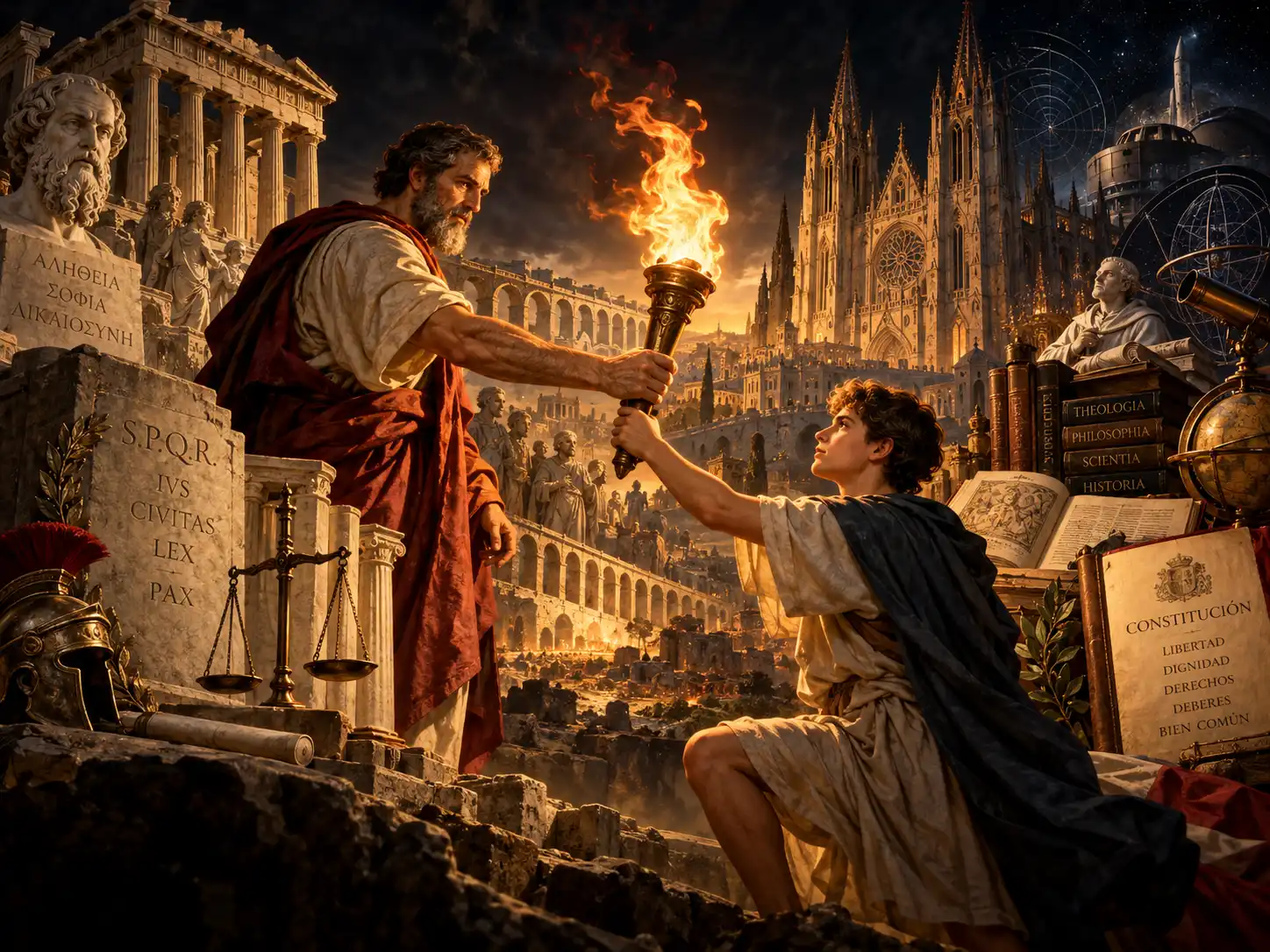
Western civilization is not something that has occurred spontaneously nor a heritage that is automatically preserved. It is precisely a completely unique cultural achievement. It is the result of an extraordinary historical accumulation: Greek philosophy, Roman law, Judeo-Christian tradition, modern science, constitutionalism, the division of powers, individual freedoms, and the recognition of human dignity. None of this appeared overnight. Nor is it guaranteed to endure forever.

Each generation has the responsibility to receive that legacy, understand it, and transmit it.

Wars were fought to maintain these values; those who died today cry out for the self-renunciation that shakes Europe. And here lies, in my view, one of the great contemporary challenges of the West: to recover education as an instrument for transmitting knowledge, culture, values, and principles, and not as a tool of social engineering at the service of a particular ideological current.

It is not about returning uncritically to the past, nor about preventing new generations from building something different. It is about enabling them to do so on the shoulders of those who preceded them and not from the ignorance of everything that existed before.

Freedom requires educated citizens. Freedom does not defend itself. Democracy requires citizens capable of thinking. And civilization needs generations that know what they have the responsibility to preserve. We are all born without knowing the world we inherit. The true responsibility lies with the adults and the institutions that must educate them.

Western civilization is an exception, an anomaly of freedom and progress, surrounded by enemies. It has often been on the brink of disappearance; but it has always prevailed.

The current challenge is much worse than external enemies: Western civilization has handed over education to a device that has stopped transmitting to our children the reasons why it is worth defending our civilization.

And perhaps that is the most important battle of our time: to ensure that new generations do not have to rediscover, from scratch, what it took the West centuries to build.