The president Javier Milei presented on Thursday his strategic vision to position Argentina as a global center for artificial intelligence (AI) development, through a column published in the Financial Times.
In the article titled "Argentina invites AI to free itself", the president defended the creation of a legal framework aimed at maximizing technological development freedom with minimal state intervention.
In his presentation, Milei sought to highlight the country's economic turnaround as a basis for attracting investments. "This is also, it should be said, an invitation. Argentina has transformed in the last two years. Inflation, which was once an existential threat, has been controlled, although the work is not yet finished", he stated.
The head of state maintained that macroeconomic order was key to reversing years of stagnation. "The fiscal surplus, combined with the deepest deregulation program in the world, has returned the economy to a growth path after 15 years of stagnation. Investments are flowing into our world-class energy and mining resources, located in a region whose geopolitical stability is increasingly scarce", he emphasized.
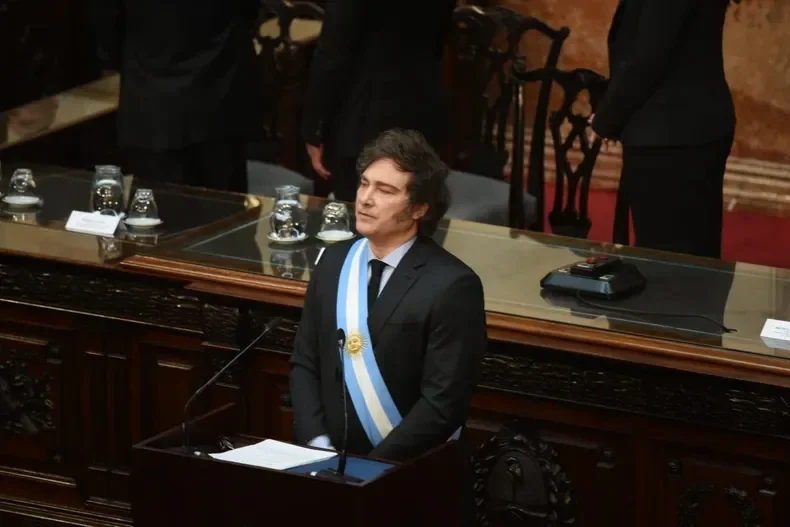
President Javier Milei.
In this context, Milei proposed a strategy of economic openness specifically aimed at the technology sector. "We are open for business. With the same spirit as the Dutch merchants who turned Amsterdam into the financial capital of the 17th century, we seek to offer the most attractive legal and tax environment for the Artificial Intelligence companies that will define the 21st century", he expressed.
He added: "May Buenos Aires be to Artificial Intelligence what Amsterdam was to the age of navigation: the place where legal imagination matched the technological moment and changed the world".
The article, prepared with the collaboration of the Minister of Deregulation and State Transformation, Federico Sturzenegger, posits that AI represents a change of magnitude comparable to the Industrial Revolution.
"At the beginning of the Industrial Revolution, Adam Smith illustrated the potential of technology and economies of scale with his famous description of the pin factory. And just as the Industrial Revolution freed us from the limitations of human muscle, AI will free us from the limitations of the human brain, driving productivity beyond what is imaginable," the President noted.
President Javier Milei.
The initiatives of Milei's Government
As part of this agenda, the Government has already sent a specific bill to Congress to regulate the development of artificial intelligence. As Milei explained, the initiative is based on three main pillars. The first is "the commitment to keep AI unregulated so that it can develop freely, without the pressure of premature and misunderstood regulation".
The second pillar introduces an innovation in the Argentine legal system: "the creation of a new corporate category in Argentine legislation: the non-human corporation". According to the president, "these are entities operated by AI agents or robots".
In this regard, he clarified that "when these systems exercise independent judgment in unpredictable environments —as they must to be truly useful— their actions carry real risks. Limited liability is not a luxury for these entities; it is an indispensable condition for their existence. Human shareholders may participate, but it is not mandatory".
President Javier Milei.
The third pillar aims to consolidate a competitive tax scheme to attract investments. "These corporations will benefit from a low corporate tax rate, and shareholders will be able to choose the corporate governance law they prefer", he indicated.
Moreover, he emphasized that "the ultimate beneficiaries must be identified —Argentina has no interest in becoming a haven for illicit capital— but for all legitimate commercial activity, our framework will offer unmatched conditions".
The proposal is complemented by a reform of the General Companies Law, already presented by the Executive Power, which seeks to modernize the current regime. Among its central points is the creation of "automated companies", capable of operating through artificial intelligence systems without the need for human employees, and the possibility of resolving corporate conflicts in foreign jurisdictions.
Sturzenegger defined the initiative as a step towards a more flexible model, aimed at replacing "a rigid and anachronistic regime, built on distrust of the private sector", in line with the Government's goal of promoting an environment based on economic freedom and deregulation.